
- All
- Product Name
- Product Keyword
- Product Model
- Product Summary
- Product Description
- Multi Field Search
Languages
Views: 875 Author: Site Editor Publish Time: 2025-12-29 Origin: Site


Content Menu
● Clay Bar vs Clay Mitt Chemistry: Material Science, Performance & Paint Safety
● Clay Bar vs Clay Mitt — Chemistry Comparison
● Role of Clay Lubricants in Paint Safety
● Which Tool Is Safer for Automotive Paint?
● FAQ – Clay Bar vs Clay Mitt Chemistry
>> Q1: Is a clay mitt chemically safer than a clay bar?
>> Q2: Can clay bars damage clear coat?
>> Q3: Are clay mitts made of rubber?
>> Q4: Does Brilliachem manufacture both clay tools and lubricants?
● Summary
The primary difference between a clay bar and a clay mitt lies in their polymer chemistry and surface interaction mechanisms.
Clay bars use elastic resin-based polymers to shear bonded contaminants from automotive paint, while clay mitts feature synthetic rubberized polymers engineered for consistent friction and faster coverage. When combined with proper clay lubricants, both tools are paint-safe, but their chemistry determines efficiency, durability, and contaminant removal performance.
A clay bar is a resin-based elastic polymer designed to mechanically shear and embed contaminants from vehicle paint. Its flexibility allows it to conform to curves and surfaces while lifting bonded particles, including brake dust, industrial fallout, and tree sap.
Key Points:
Elastic, resin-based polymer matrix
High flexibility for surface contact
Contaminant absorption within polymer structure
Clay bars function through controlled elastic deformation, allowing contaminants to be safely lifted and trapped in the polymer.
A clay mitt is a synthetic rubberized polymer tool typically layered over microfiber or sponge, providing:
Controlled friction for contaminant removal
Reusable performance with proper care
Faster coverage of large surfaces
Clay mitts use engineered synthetic rubber polymers for consistent glide and surface-safe decontamination.
| Feature | Clay Bar | Clay Mitt |
|---|---|---|
| Core Material | Resin-based elastic polymer | Synthetic rubber polymer |
| Flexibility | High | Medium |
| Contaminant Capture | Embedded absorption | Surface absorption |
| Durability | Single-use risk | Reusable |
| Lubricant Dependency | Very High | High |
Both clay bars and clay mitts require proper lubrication to minimize friction and prevent marring:
Reduces direct polymer-to-paint contact
Stabilizes shear forces during decontamination
Enhances glide and contaminant suspension
Without suitable clay lubricant, even high-quality clay tools may cause micro-marring or haze.
Beginner users or quick washes: Clay Mitt
High-end detailing or precision work: Clay Bar
Sensitive clear coats or coatings: Lubricant chemistry is more important than the tool type
Brilliachem recommendation: Always pair clay tools with professionally formulated clay lubricants for optimal paint safety.
As a professional car care chemical manufacturer, Brilliachem develops clay bars, clay mitts, and clay lubricants with:
Paint-safe polymer chemistry
OEM & private label capabilities
Global detailing brand support
Our approach focuses on material compatibility and chemical performance, not just surface cleaning.
A1: Not inherently. Safety depends on polymer quality and lubricant use.
A2: Only if used without sufficient lubrication or on heavily contaminated surfaces.
A3: Yes, most feature engineered synthetic rubber polymers.
A4: Yes. Brilliachem provides integrated clay systems for professional brands.
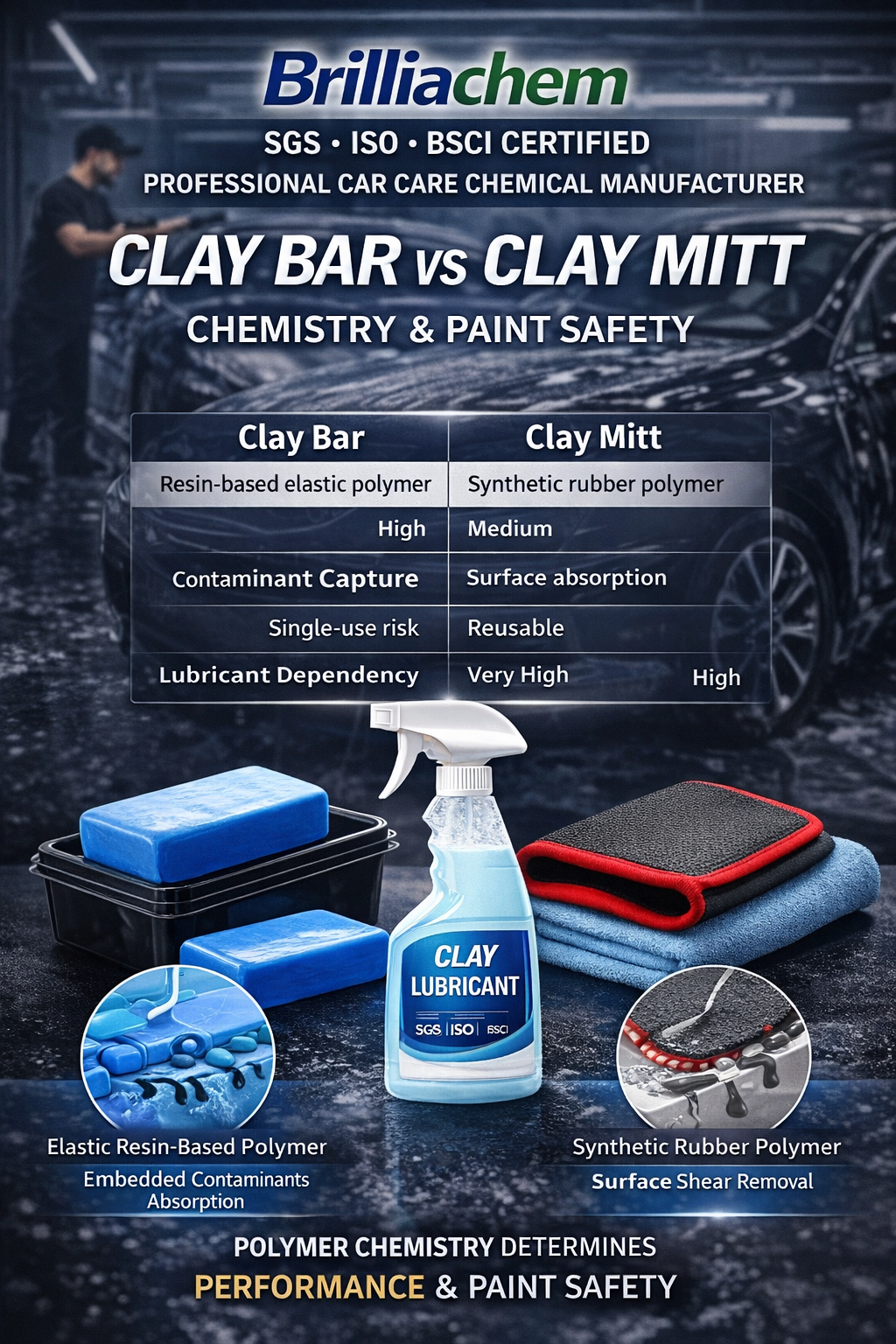
Clay bars and clay mitts differ primarily in polymer chemistry and contaminant interaction mechanisms. Understanding material science, lubrication chemistry, and paint safety principles is essential for effective decontamination. Brilliachem, as a certified car care chemical manufacturer, delivers scientifically engineered clay systems — including clay bars, clay mitts, and lubricants — optimized for global detailing brands and OEM clients.


